




What Determines an Electric Scooter’s Range? The Real Factors
If the manufacturer claims that an electric scooter can travel up to 50 kilometres on a single charge, but you can barely manage 30 km, you are not alone. This difference is completely normal — and there are a whole range of factors that determine how far an electric scooter (or any other electric bike or personal electric vehicle) can actually travel.
Manufacturers test their models under specific conditions: smooth, flat asphalt without climbs or descents, no wind, warm weather, an average-sized rider (depending on the manufacturer, typically 65–75 kg and 165–175 cm), a constant speed — usually around 15 km/h — and smooth riding without stops. It is also important that the tires are inflated to the recommended pressure, the battery is fully charged, and the scooter is in proper technical condition.
Real-life urban riding rarely matches these ideal conditions.
Let’s take a closer look at what actually determines how far your electric scooter can travel on a single charge.
1. Rider Weight
Weight is one of the biggest factors affecting range. This includes not only the rider’s body weight and riding gear, but also anything being carried, such as a backpack, bag, or shopping.
The heavier the total load, the harder the motor has to work and the faster the battery is depleted.
If the manufacturer tested the scooter with a 75 kg rider, a 90 kg rider may experience a real-world range reduction of around 10–20%.
Frequent acceleration and braking also require more energy with a heavier load. If you want to maximize your range, carry only what you actually need 🙂.
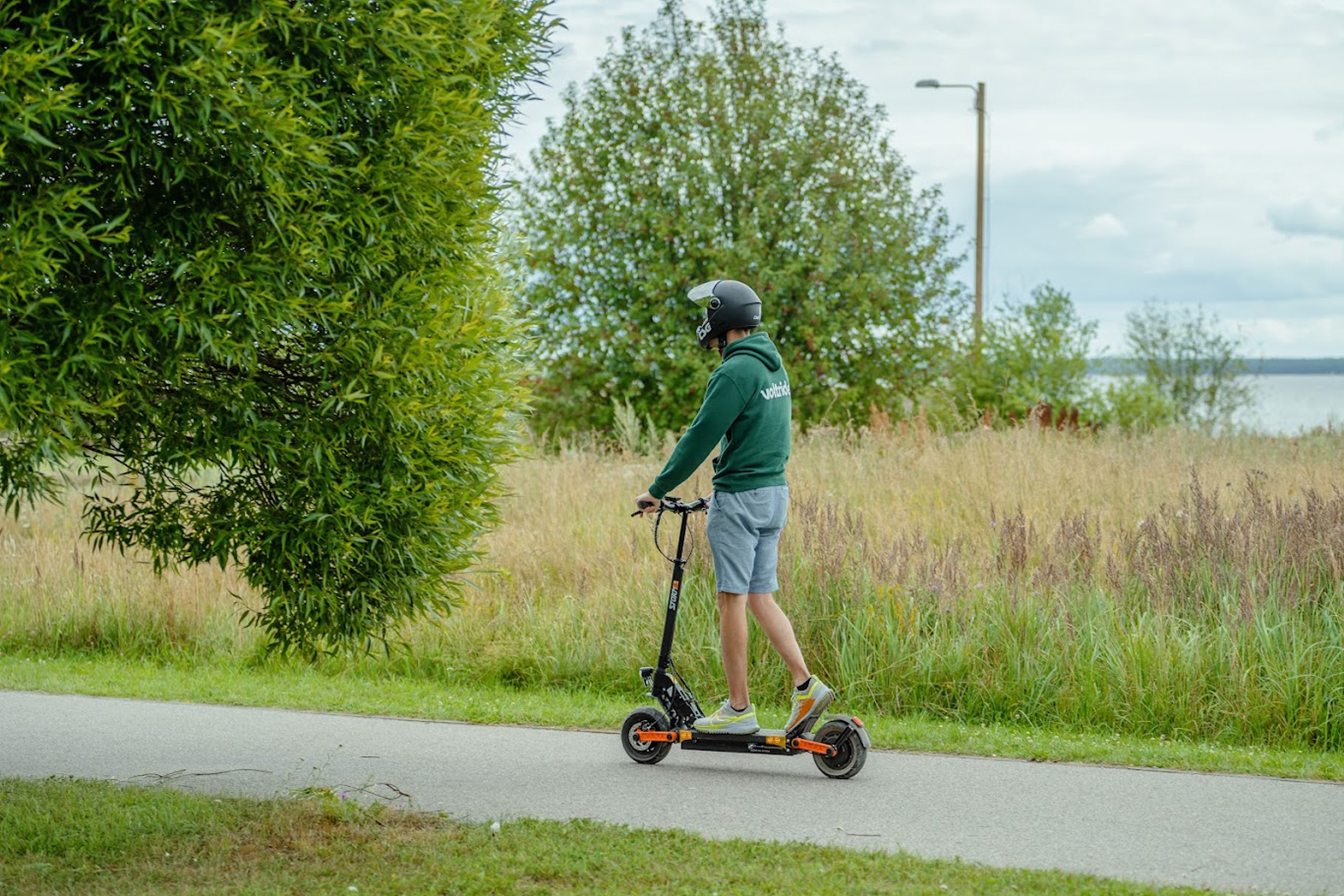
2. Speed and Riding Style
Speed is another major factor. An electric scooter’s energy consumption does not increase linearly with speed — it rises progressively as you go faster because aerodynamic drag increases significantly.
The rider’s height and build also play a role. A tall, broad-shouldered man may travel a considerably shorter distance at the same speed than a shorter, smaller rider because of the greater frontal area and aerodynamic drag.
If you want to travel further, you can reduce your frontal area by turning slightly sideways on the deck or crouching down. Or simply keep your speed below 15 km/h.
There is a reason cyclists wear aerodynamic clothing and carefully optimise their riding position — reducing aerodynamic drag means reducing energy consumption.
Smooth, steady riding is the most efficient. If you constantly ride at maximum speed, use Sport mode, and accelerate aggressively, you may lose as much as half of the advertised maximum range.
Eco mode may get you there a little more slowly, but it can significantly increase the distance you can travel.
3. Terrain and Road Conditions
The road surface itself also has a major impact.
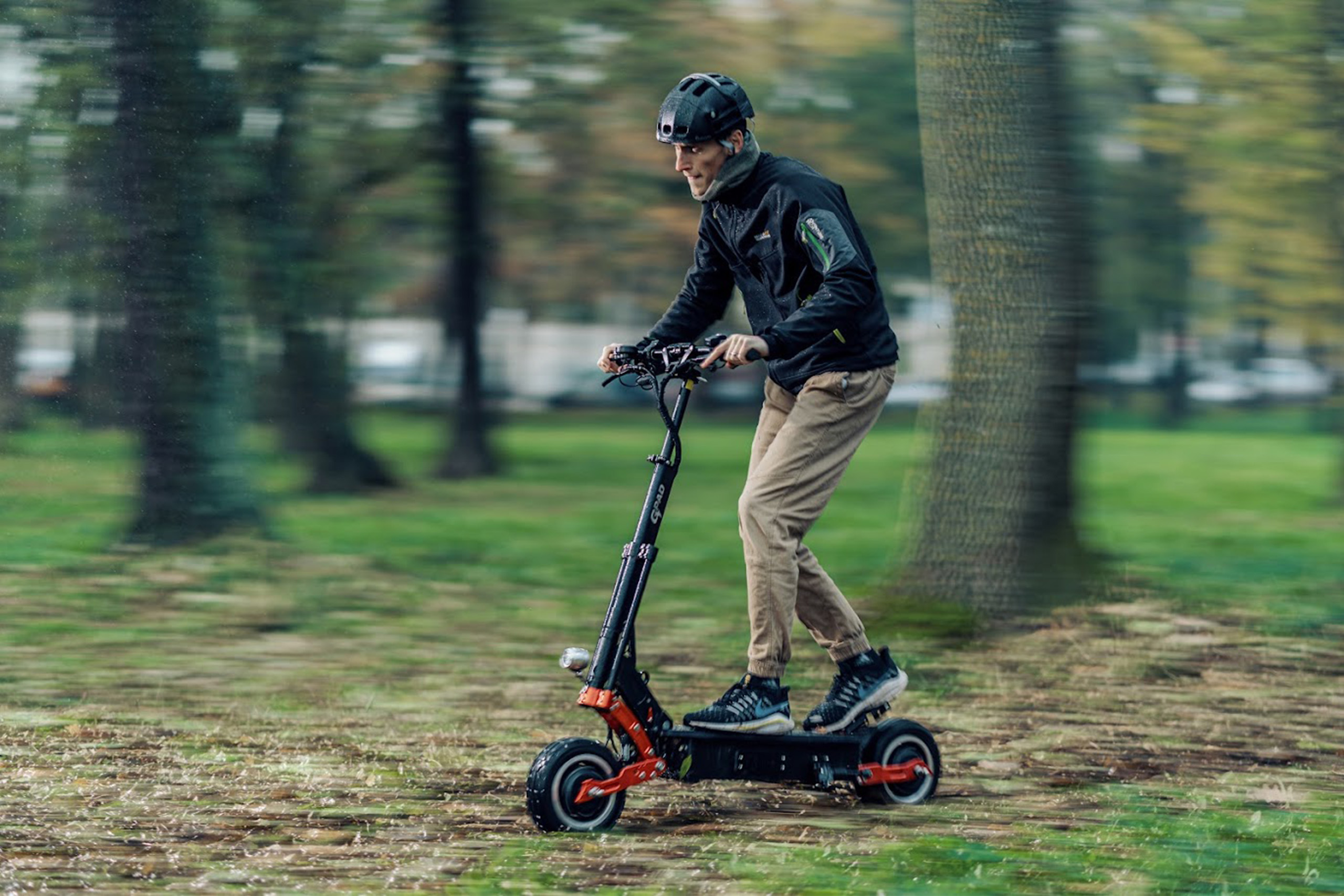
An electric scooter is most efficient on smooth, flat asphalt because rolling resistance is minimal. Hilly gravel roads or soft forest trails, on the other hand, require considerably more work from the motor.
Climbing hills and riding on uneven surfaces increases energy consumption, while some models can recover a small amount of energy when travelling downhill through regenerative braking.
If your usual routes are hilly or the road surfaces are poor, it is worth considering this when buying a scooter and choosing a model with a slightly larger battery.
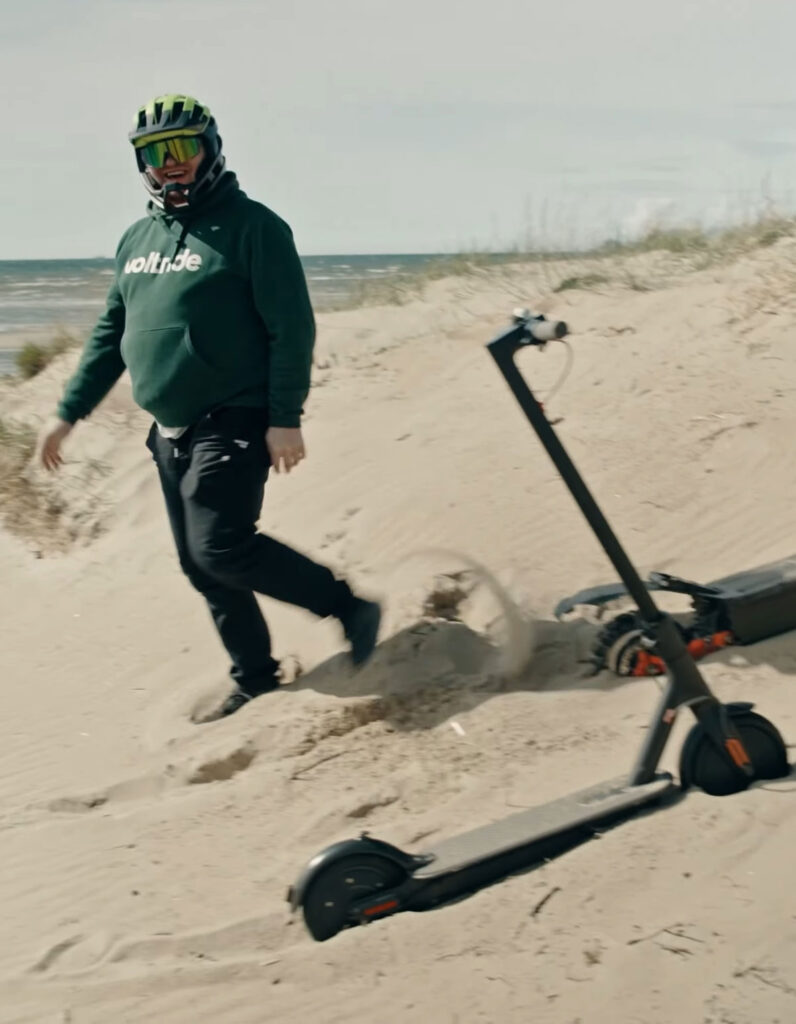
Enthusiasts who regularly ride off-road know that with even moderately aggressive forest riding, the actual range can drop to just 25–35% of the manufacturer’s advertised maximum.
4. Weather and Temperature
Weather affects range more than you might initially expect.
Cold weather — already below approximately +10°C — reduces battery efficiency because low temperatures slow down the chemical processes inside a lithium-ion battery. As a result, the battery can deliver less usable energy and the scooter travels a shorter distance.
During autumn and winter, a scooter that achieves 50 km in summer may easily be limited to around 30–35 km.
A strong headwind has an effect similar to riding uphill: the motor has to work harder to maintain the same speed.
Warm, calm weather is the most favorable combination for both the battery and maximum range.
5. Tire Pressure and Maintenance
A surprising number of range problems can be solved simply by correcting tire pressure.
Underinflated tires increase rolling resistance, which means the motor has to work harder and the battery drains faster.
Always keep your tires inflated to the manufacturer’s recommended pressure — typically around 45–55 PSI — and check the pressure approximately once a week.
Tire profile also has a significant effect on range. A wide, heavily treaded tire running at low pressure can consume considerably more energy than a narrow, high-pressure road tire.
Correctly inflated tires not only improve efficiency but also make riding safer.
6. Battery Condition and Age
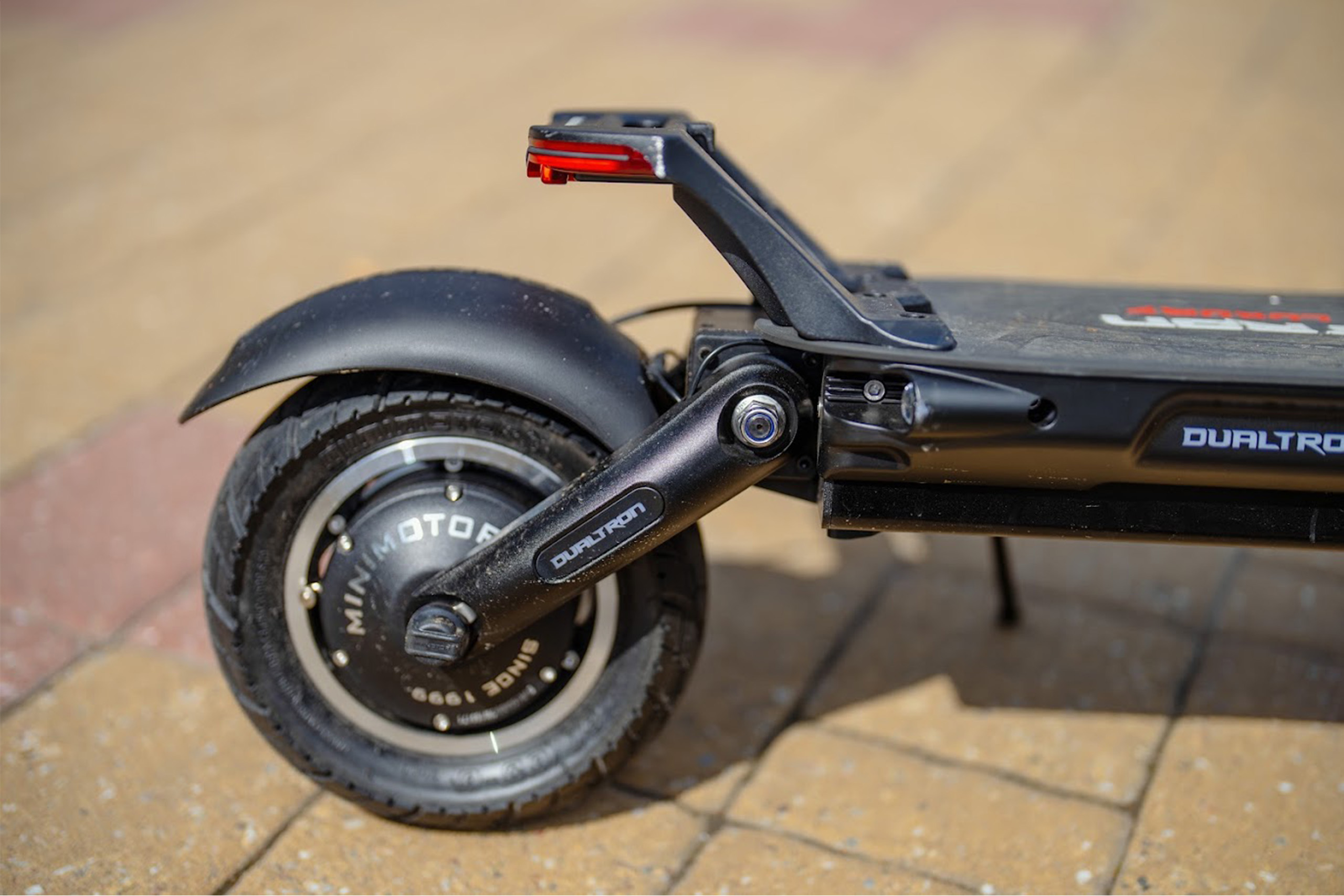
Every battery gradually degrades with use — this is completely normal.
After approximately 500 charging cycles, a battery may typically have around 60–70% of its original capacity remaining. This means that a two- or three-year-old electric scooter may no longer travel as far as it did when it was new, even if everything else is functioning correctly.
Good charging habits can help extend battery life. Avoid completely draining the battery, do not routinely leave it charging overnight, and during winter, store the scooter or battery indoors rather than in a freezing garage.
7. How Does Energy Consumption Affect Electric Scooter Range?
If you do not have the time or opportunity to perform a real-world range test, you can estimate an electric scooter’s range in much the same way as you would calculate the range of a car based on fuel consumption.
With a car, we usually talk about how many litres of fuel are consumed per 100 km. Depending on the vehicle, this could be anywhere from around 3.5 to 13 litres.
To calculate the range, we compare the size of the fuel tank with average fuel consumption. For example, if a car has a 60-litre fuel tank and consumes an average of 6 litres per 100 km, its theoretical maximum range is around 1,000 km on a full tank.
Electric scooters work in essentially the same way.
Instead of a fuel tank, we have a battery, with its capacity measured in watt-hours (Wh). Instead of litres of fuel, we measure how many watt-hours are required to travel one kilometre (Wh/km).
For example, the Segway Max G3 has a battery capacity of 597 Wh, and according to the manufacturer, it can travel up to 80 km under highly efficient riding conditions.
We can therefore calculate its theoretical energy consumption per kilometre: 597 Wh/80 km = 7.45 Wh/km
Voltride has carried out countless real-world range tests, and we can confirm that such low electric scooter “fuel consumption” is theoretically possible. Unfortunately, there can be a Grand Canyon-sized gap between theory and practice.
Here are some useful reference points for the energy consumption that a rider weighing approximately 75 kg could expect under different riding conditions:
- Eco riding — approximately 10 Wh/km. With a Segway Max G3, this would mean a realistic range of up to approximately 60 km.
- Normal urban riding — approximately 12–15 Wh/km. Realistic range: approximately 40–50 km.
- Aggressive riding, climbs and descents with the speed restriction removed — approximately 18–20 Wh/km. Realistic range: approximately 30–35 km.
- Riding on soft terrain — approximately 20–25 Wh/km. Realistic range: approximately 24–28 km.
If the rider is heavier or taller, the tires are incorrectly inflated, the temperature is below +5°C, there is a strong headwind, or other unfavorable conditions are present, the range may decrease even further.
Battery ageing also reduces the achievable range over time.
How to Increase Your Electric Scooter’s Range
- Ride smoothly and maintain a steady speed; use Eco mode when appropriate.
- Keep your tires at the correct pressure and your scooter properly maintained.
- Avoid full-throttle acceleration and sudden braking.
- Keep your clothing and riding position as aerodynamic as reasonably possible.
- Reduce unnecessary weight and avoid carrying things you do not need.
These simple steps can bring your real-world range considerably closer to the manufacturer’s ideal figures while also helping to extend battery life.
Conclusion
The range advertised by the manufacturer should be viewed primarily as a theoretical maximum rather than a guaranteed distance.
The actual distance you can travel depends on the rider, weather, terrain, riding style, and the technical condition of the scooter.
Once you understand how these factors affect energy consumption, you can plan your journeys more accurately and reduce the risk of running out of battery halfway to your destination.
Voltride can also help you check both the condition of your battery and the overall technical condition of your electric scooter — so you can understand why the range may have decreased and what can be done to maximize it again.
See what our customers say








Since 2016 Voltride has shipped over 12,000 packages to private and B2B customers


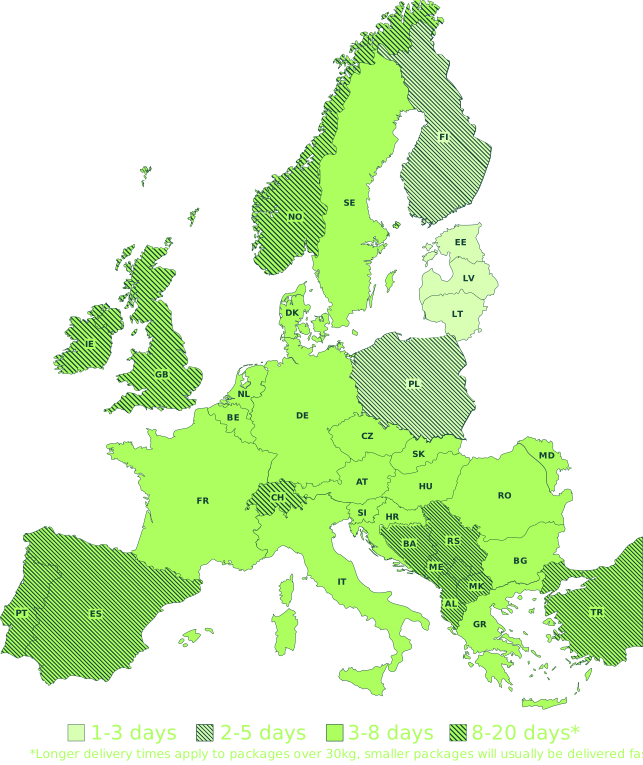
Fast Shipping all across Europe
Watch Us in Action
Voltride for Commuters, Active Riders and Professional Users
Voltride started in 2016 as a family company gathering enthusiasts and specialists to attract more and more people and businesses to the electric lifestyle. Lifestyle of fun and function, or to put it more elegantly: commuters, active riders and professional users in delivery, tourism and business operations. Voltride is one of the largest players in Scandinavia and the Baltics in the area of personal electric mobility, serving customers across Europe.
Over 12,000 items shipped
2,000 + products and spare parts available in stock
Deliveries to over 34 countries




 About Us


